
How much does a company family day cost in Singapore?
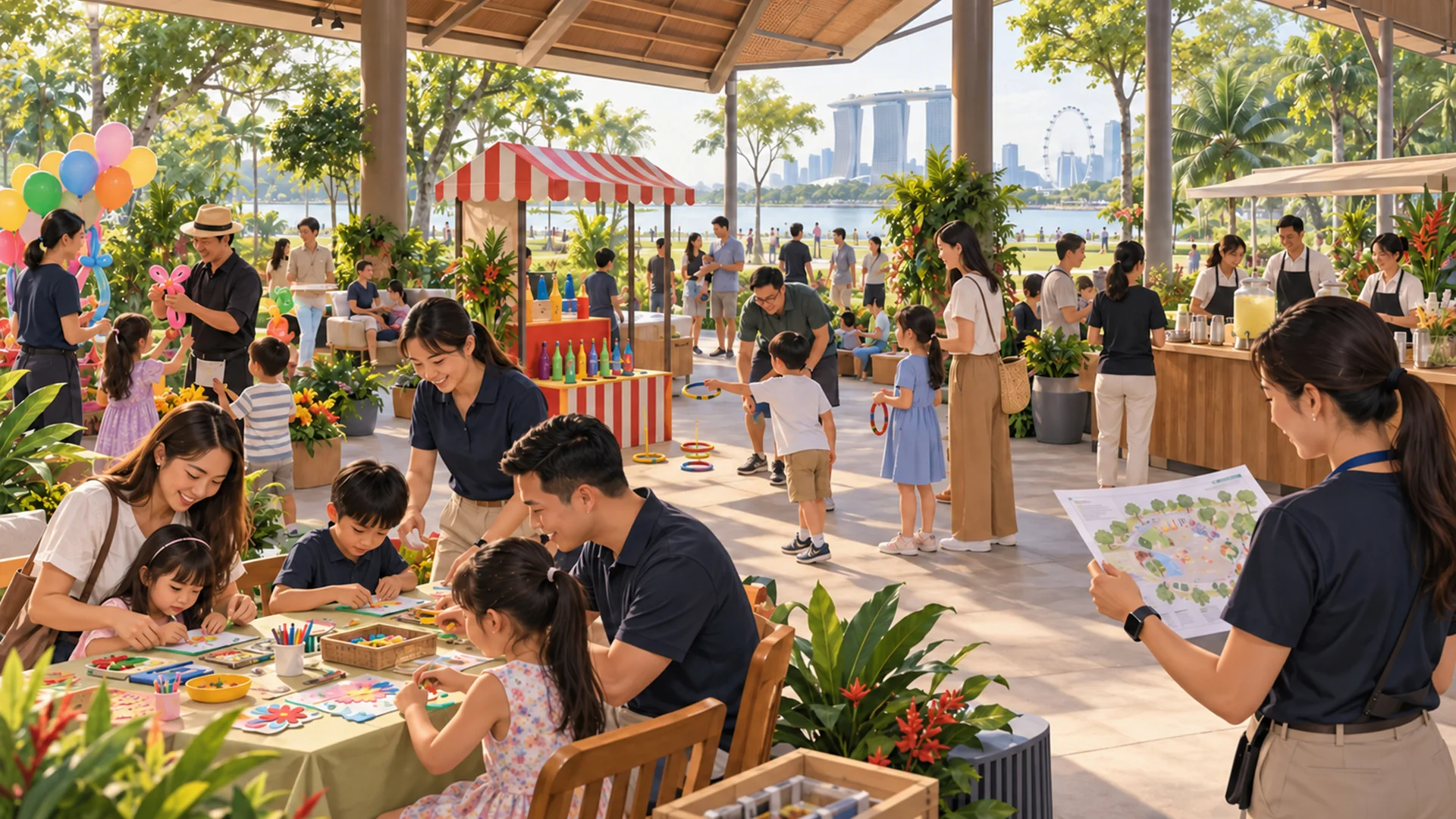
Build a company family day budget around adult and child attendance, activity capacity, venue, food, décor, shelter and coordination. Check what each service actually covers.
How much does a company family day cost?
The cost of a company family day depends on who is attending and how the day will work. Separate employees, partners and children, then note the children’s age ranges. A drop-in carnival, timed workshops and a shared stage programme need different staffing, space and service periods.
For initial activity comparisons, carnival game rentals can be around SGD 300 to 600 for different quantities, while a facilitated tote-bag painting activity can be around SGD 550 to 800 for different durations. A compact balloon arch can be around SGD 400 to 600. These are separate planning allowances; they do not establish a complete price per family or per person.
Set the attendance and venue plan first
Confirm expected attendance, registration arrangements and how long families will stay. Check access, toilets, pushchair routes, seating and quiet space. These requirements should shape the venue shortlist before optional activities are selected.
Venue hire and food need their own quotations. For an outdoor or rooftop setting, include shelter and a weather plan rather than assuming an indoor activity setup can move outside unchanged. Confirm loading access and setup windows as well.
If the venue is a café, restaurant or office lounge, check the usable event area and whether other guests or staff will share the space. The plan should show circulation as well as activity positions.
Compare staffed activities by capacity and duration
Game rentals and staffed activities are different purchases. Ask whether tables, supervision, game masters, prizes and consumables are included. More equipment does not automatically provide more usable capacity if staffing or space is limited.
For a facilitated activity, confirm the number of participants per session, session length and rotation plan. Estimate demand from the age profile and programme, then check whether additional sessions or facilitators are required. Do not assume one station can serve the whole event.
Map queues before adding decorative features. Facilitators need room to work and clear sightlines, particularly when younger children are taking part.
Separate meals, refreshments and shelter
Decide whether families need a main meal, snacks or both. Confirm serving times, dietary and allergen information with the appointed food provider. Refreshment stations need space, power and waste arrangements; they should not silently replace the main catering requirement.
For a longer event, consider where families can sit, rest and find drinking water. Outdoor venues also need a clear plan for rain, heat and shelter. Agree who monitors conditions and who can change the programme.
Keep each requirement visible in the budget. An activity subtotal without venue, food, shelter and staffing should not be labelled a complete family day price.
Allocate décor and coordination separately
Use décor to welcome families, identify activity zones and create a photo area. A customised arch-panel feature can be around SGD 500 to 750. Choose the footprint around circulation, supervision and the venue, with materials and installation stated clearly.
For planning and coordination, an initial comparison can be around SGD 1,545 to 2,480 for different scopes. Confirm vendor liaison, preparation and event-day coverage. Supplier delivery does not automatically provide someone to manage queues, transitions or last-minute issues.
The company family day event decoration guide covers cafés, restaurants, office lounges and rooftop spaces. Use it to connect the styling brief with practical venue decisions.
Approve a complete budget against the programme
Add the agreed venue, food, activities, décor, staffing, shelter, technical production and coordination costs. Confirm transport, setup, removal, labour and taxes. Identify what is still awaiting a quotation rather than hiding gaps inside an activity allowance.
For a per-person comparison, divide the complete budget by a clearly stated attendance basis. State whether it includes employees, partners and children. Give stakeholders the scope alongside the figure so they can compare value without mistaking a partial subtotal for the whole day.